In October 2019, the Institute of the Information Society at University of Public Service carried out a comprehensive survey to find out how much trust Hungarian people have in the actors and services of the information society, how consciously they participate in the online world, and what risks they perceive in the spread of new technologies. The survey was repeated in November 2021 to get a picture of the changes brought about by the first three waves of the coronavirus epidemic. Both surveys are representative of the Hungarian population by age, gender, education and type of municipality, and are conducted by telephone. In our first sub-report, we highlight key changes in the functioning of the public sphere.
1. The hunger for information caused by the pandemic has increased the rate of active news consumption
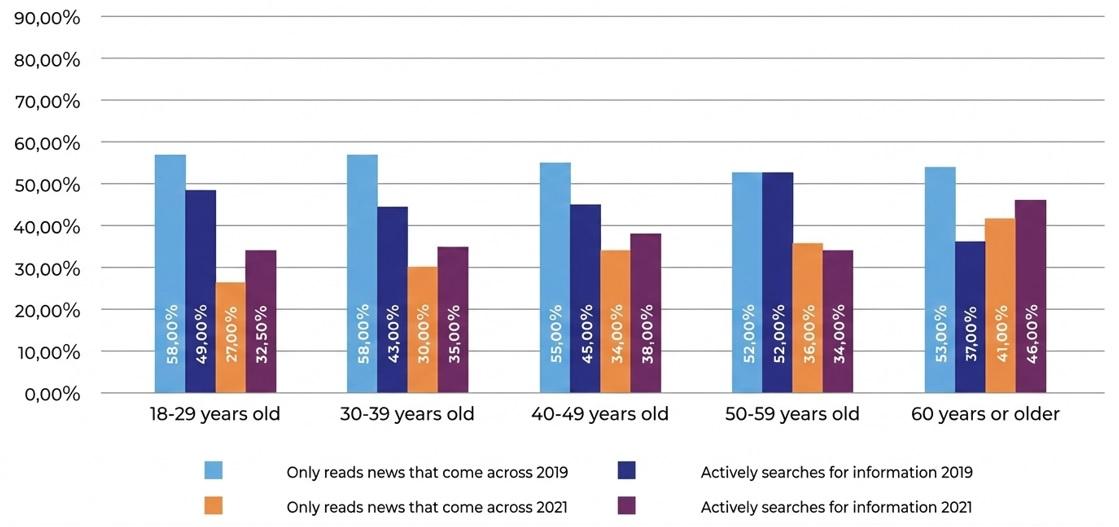
Respondents are more active in their news consumption than they were before the pandemic. While in the previous survey, 55% of the Hungarian population only read the news that came their way, and only 34% actively sought out public affairs news, by the time of the fourth wave of the pandemic, significantly fewer (44%) described themselves as "passive" news consumers, and there was a slight increase (38%) in the number of those who actively sought out information. This is particularly true for the oldest age group: among those over 60, there is already a significant increase in the number of people who actively seek out public news themselves and do not rely solely on the information presented to them for their information.
FIGURE 1: ACTIVE AND PASSIVE NEWS CONSUMPTION AMONG THE HUNGARIAN POPULATION – BY AGE GROUP, 2019–2021 (ROUNDED VALUES)
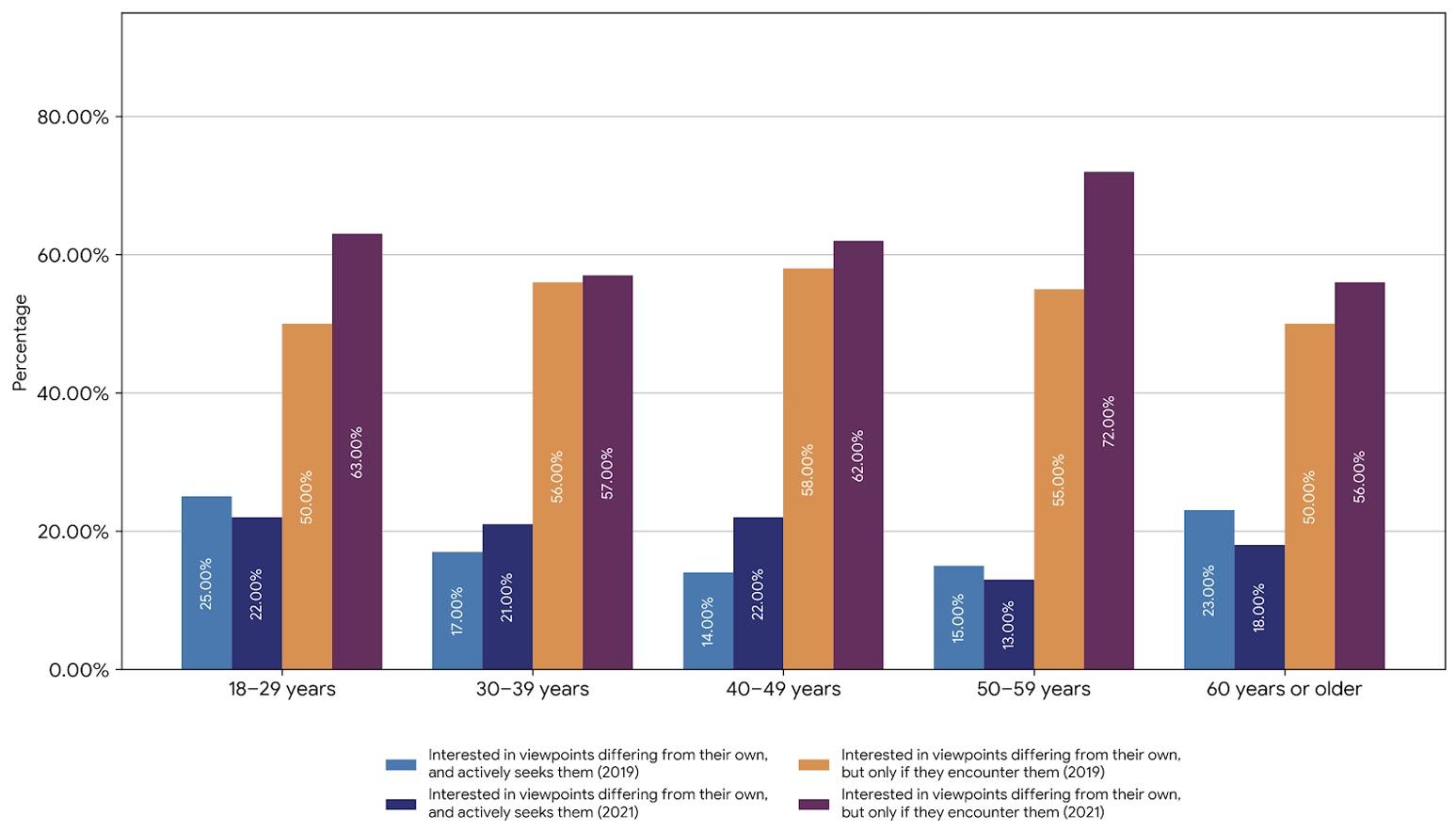
In addition, the proportion of those who are interested in positions that differ from their own convictions in relation to public affairs news has increased significantly, from 72% to 80%.
FIGURE 2: INTEREST IN AND ACTIVITY RELATED TO PUBLIC OPINIONS THAT DIFFER FROM ONE'S OWN CONVICTIONS – BY AGE GROUP, 2019-2021 (ROUNDED VALUES)
2. Growing distrust in the value of expressing opinions on the internet
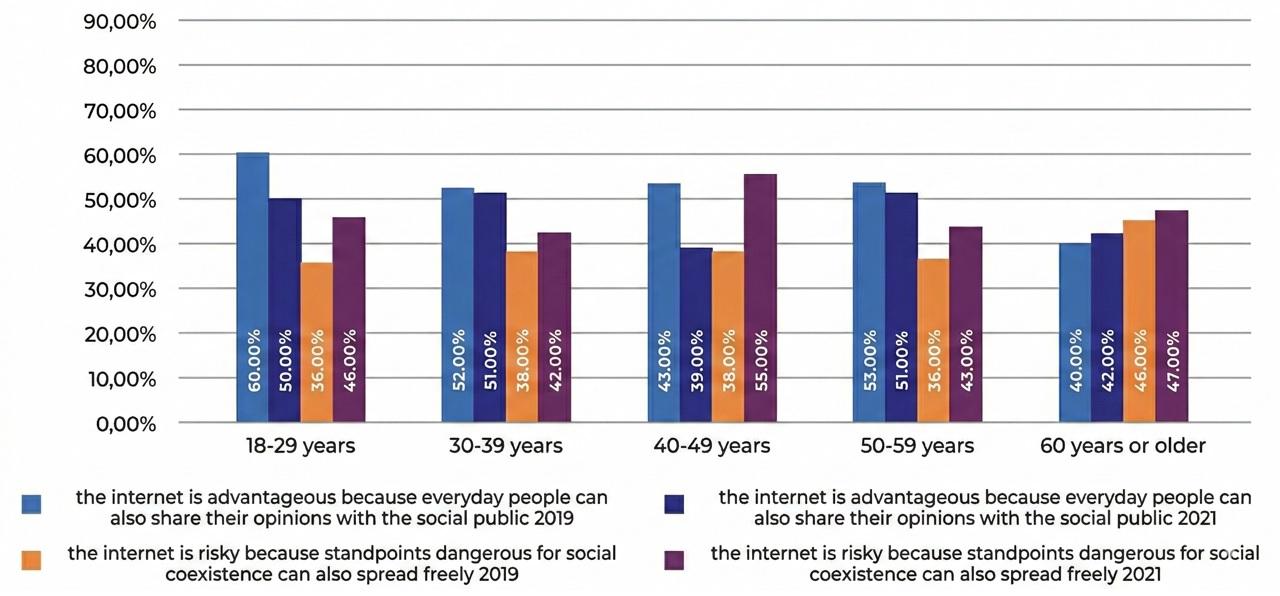
While previously a relative majority (49% vs. 40%) believed that "the internet is beneficial because ordinary people can share their opinions with the public," today, a slight majority (47.1% vs. 45.7%) believe that "the internet is risky because it allows the free spread of views that are dangerous to social coexistence." The change is particularly striking among 18-29 year olds, where the 24% advantage of those who trust the expression of opinions on the internet (60%–36%) has fallen to 4% (50%–46%).
FIGURE 3: THE VALUE OF THE INTERNET IN THE SPREAD OF DIFFERENT POINTS OF VIEW – BY AGE GROUP, 2019-2021 (ROUNDED VALUES)
A similar trend can be seen in the assessment of anonymous comments. The proportion of those who see this genre as an opportunity for irresponsible statements has continued to grow (from 67% to 76%), and even fewer (now 19%, down from 26.5%) believe that anonymous sharing is a good thing because it allows many people to express their opinions freely.
Report prepared by: Bernát Török
The report can be downloaded here (in Hungarian): A pandémia hatása a magyar információs társadalomra 1.