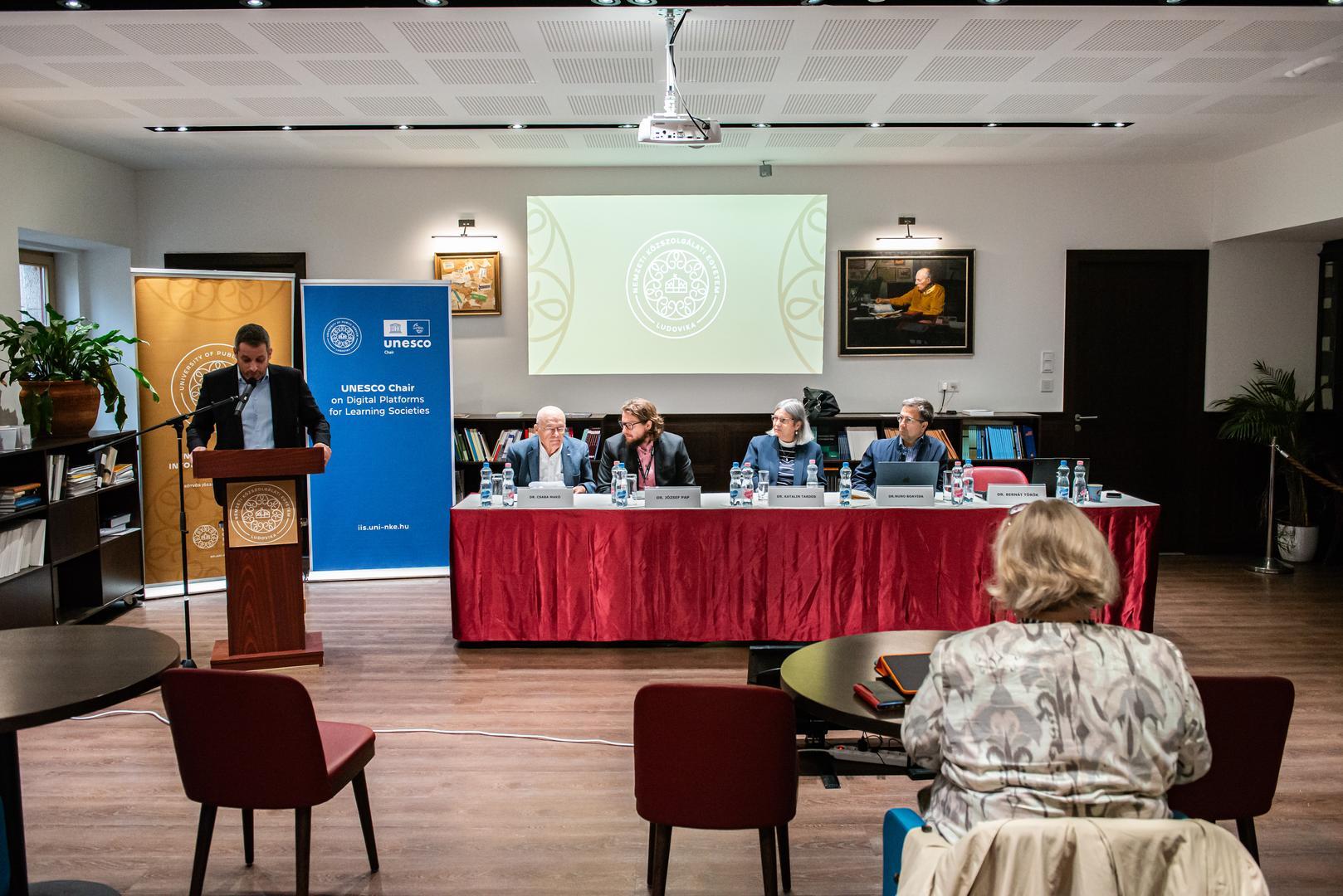

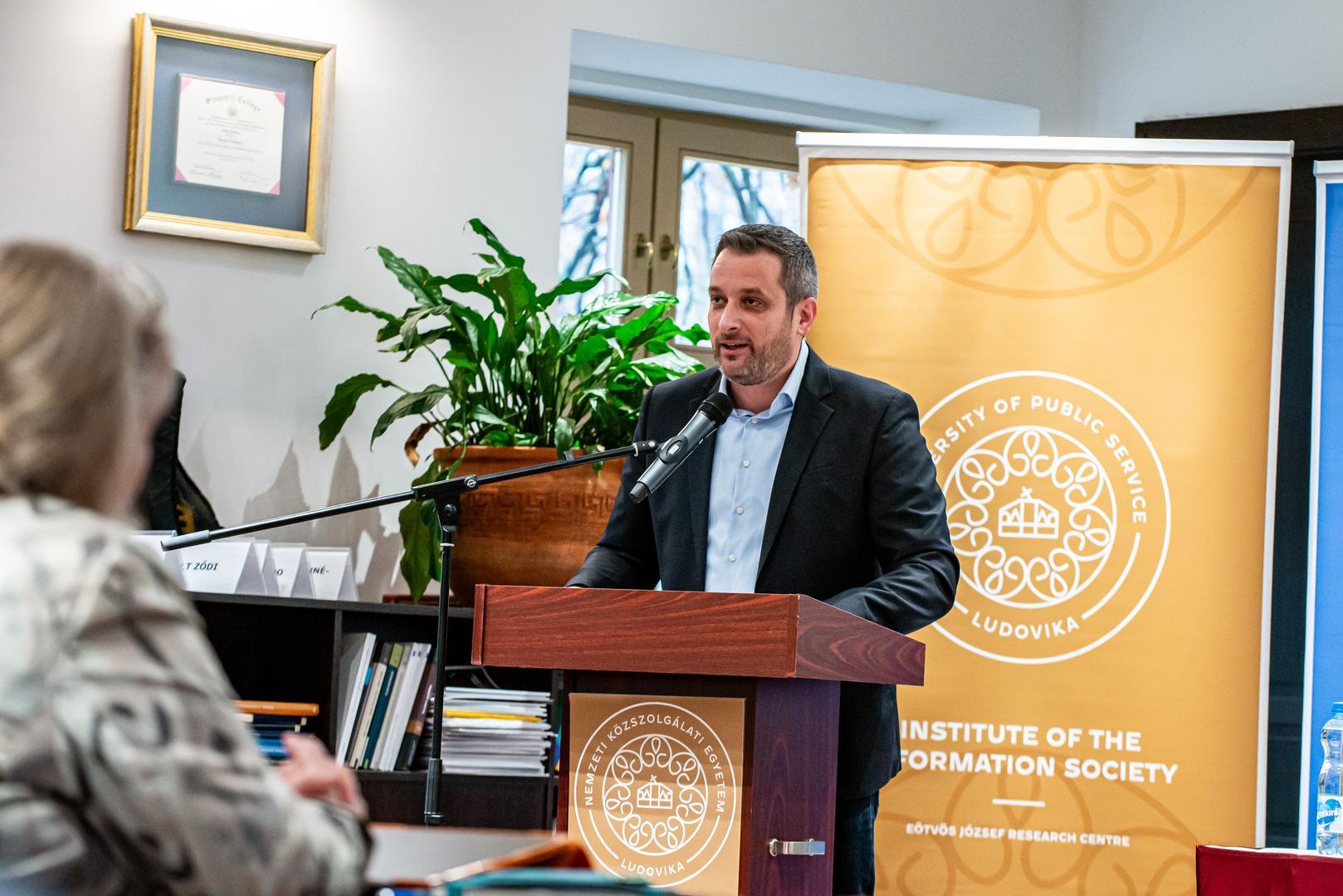

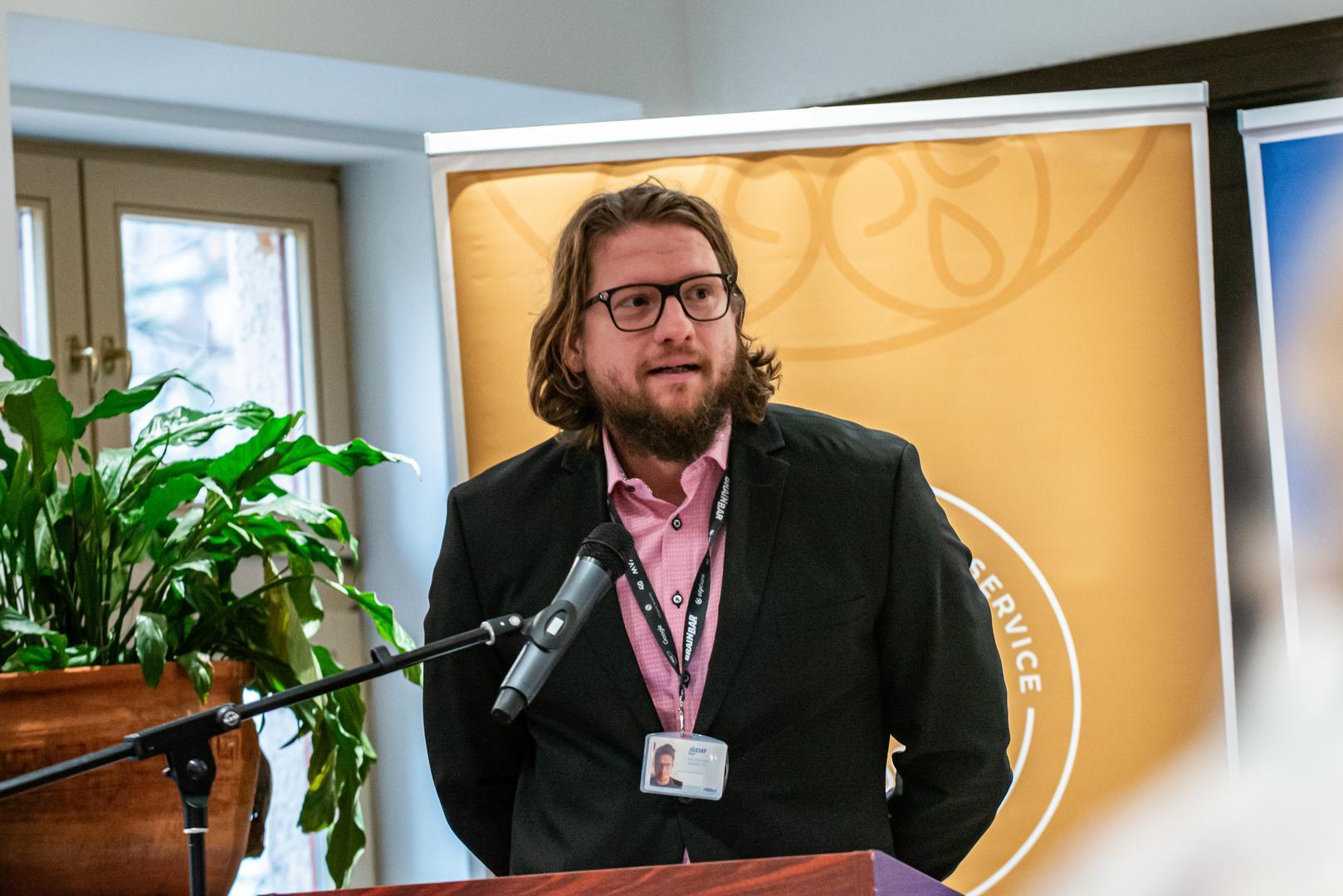
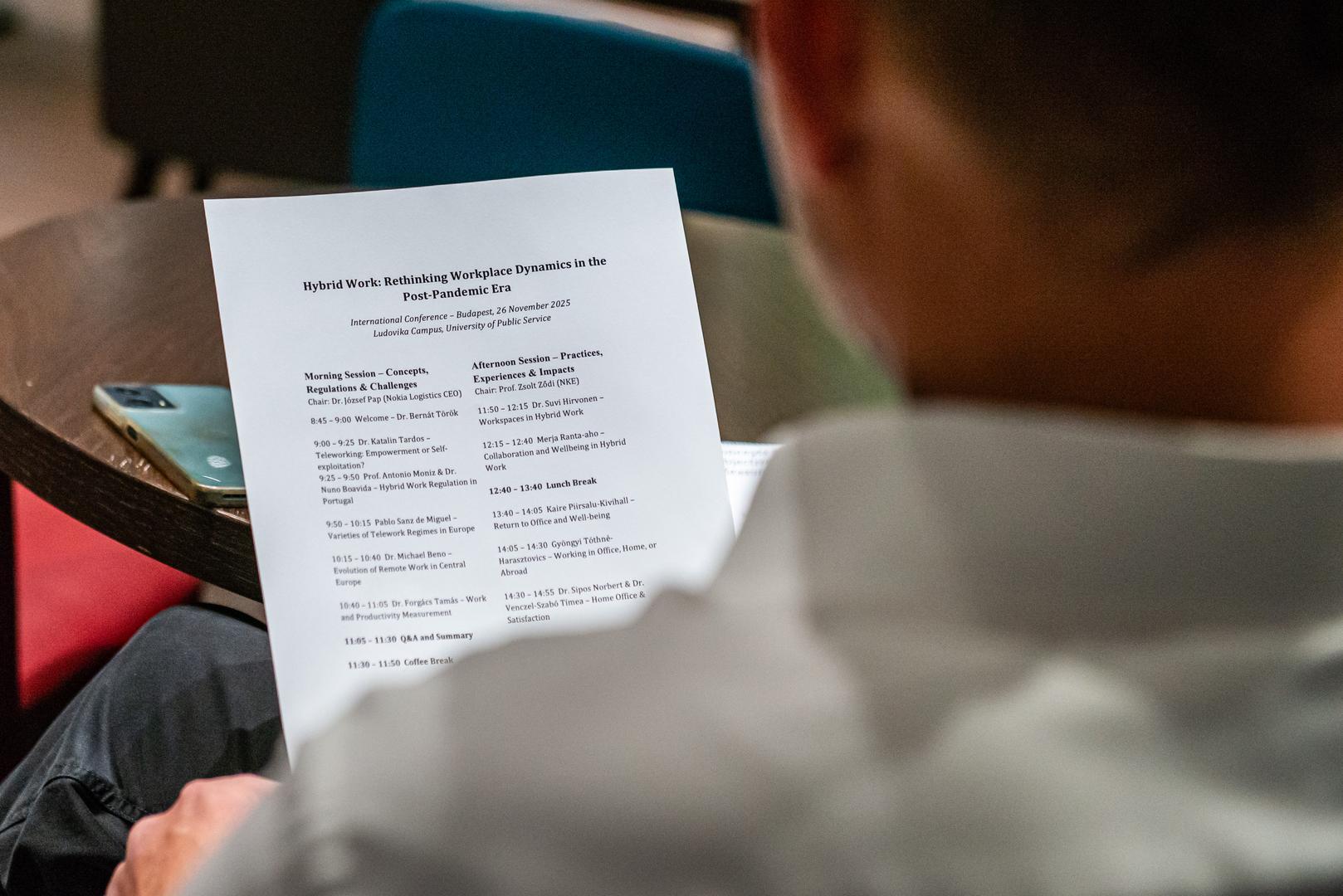

The Institute of the Information Society of the Eötvös József Research Centre at LUPS organized an international conference entitled Hybrid Work: Rethinking Workplace Dynamics in the Post-Pandemic Era on November 26, in the John Lukács Lounge of the Ludovika Side Building and online.
Work has changed: not in the academic sense of the word, but in the practical, everyday sense, said Bernát Török, director of the Eötvös József Research Centre and head of the Institute of the Information Society, in his welcoming speech at the conference. The dilemmas arose sharply during the Covid: how are we going to communicate, meet, or separate our private lives from our work? Remote working, necessitated by the exceptional and hopefully one-off pandemic, has since become accepted. The question is no longer whether to allow hybrid working, but how to make it efficient, effective, and fair. The conference will address these issues: for example, how can remote working avoid creating new privileges among employees? What rights and obligations come with remote working? How does all this affect trust in the workplace, can performance be measured objectively, and what are the consequences of algorithmic trust? What new venues are emerging that support collaboration and creativity? Is there a need for a national or EU legal framework for remote work? Bernát Török added that these are not theoretical questions, as our answers have an impact on the everyday lives of families, public transport, and even the energy sector. However, unlike during the pandemic, we can now switch from survival mode to planning mode, giving us the opportunity to work together to develop a framework for remote or hybrid working.
The dangers of workaholism
Before Covid, teleworking had a low share in the Hungarian labor market. The pandemic changed this, but subsequently the number of people choosing teleworking in Hungary declined again, said sociologist Katalin Tardos, senior researcher at ELTE HUN-REN, in her presentation entitled Teleworking: A New Form of Employee Empowerment or Self-exploitation? – A Hungarian Case Study in the Concepts, Regulations & Challenges section chaired by József Pap, CEO of Nokia Logistic. Katalin Tardos' case study was conducted at a Hungarian company, where, in addition to managers and employees, the trade union was also interviewed during the research.Before Covid, teleworking was prohibited at the company due to workplace accident regulations, lower productivity, and lack of social interaction. After the pandemic, it became prohibited again, but after this caused numerous internal conflicts, another change had to be made. Currently, the company allows two days of remote work, and with special permission, some people can choose to work remotely full-time. Employees consider the biggest benefits to be the time they have gained, the savings on travel costs, and the flexibility, but they also mentioned an increase in professional autonomy. Among the disadvantages, they mentioned the difficulty of separating work and leisure time, the development of workaholism, as well as isolation and reduced communication. Overall, however, employees consider the possibility of hybrid work to be beneficial and agree that the form of work does not determine performance. The main objection of trade unions to remote work is that the cost of hybrid work is shared between the company and the employees.
Why is a law-centered approach not good?
Portuguese labor law is a mixture of a law-centered approach and the weak collective bargaining position of employees, emphasized Nuno Boavida, a researcher at the "CICS.NOVA Interdisciplinary Centre of Social Sciences" in his presentation Struggles for Hybrid Work Regulation in Portugal: the case of teleworking, which he prepared jointly with António B. Moniz, a researcher at the Nova University of Lisbon in Portugal. According to the researchers, law has replaced dialogue in Portugal. Teleworking was already regulated in the country before the emergence of Covid, i.e., it was legally defined, but its significance remained marginal in social terms. At that time, it was still criticized that digitization gave managers excessive control over work; workers existed as data rather than in person. It was believed that autonomy without feedback and support would reduce motivation. Until the pandemic, cultural mistrust, digital deficiencies, and resistance from trade unions kept employees away from remote work. The virus found Portugal in a legally strong but institutionally weak position. During Covid, 40% of workers worked from home. According to surveys, it was typical to be constantly online, meaning that boundaries became blurred. Fifty-seven percent of those working from home were women, and since they were also responsible for housework, this created inequalities. The health crisis confirmed the importance of legislation, and the government issued new laws, but dialogue continued to be lacking. After the pandemic, hybrid work allowing for two to three days at home became the norm. Portugal wrote laws about the conditions that employers and employees in most countries negotiated, which again overrode the need for dialogue. Legal modernity has not brought about real renewal, and the control of remote work remains in the hands of workplace managers. Although participation in hybrid work is a possibility, it is not one of the alternatives for good performance.
Pioneers and followers
There are significant differences in the perception of teleworking in EU countries, which remained visible even during the pandemic, as Pablo Sanz de Miguel, a researcher at the University of Zaragoza in Spain, pointed out in his presentation entitled Varieties of Telework Regimes across European Regions: A Tale of Four Different Worlds. There are countries where there is no precise legal definition or framework for teleworking, it is more a matter of agreement between employer and employee. Elsewhere, there is a legal framework, but in reality, employees are not in a bargaining position. There are countries where attempts were made during the pandemic to protect employees through legal means, while elsewhere only the definition of telework was established during the pandemic. The study identified four groups of countries in Europe:
1. pioneers in teleworking, where employees have strong bargaining power and teleworking is widespread, even though there is virtually no legal regulation;
2. advanced teleworking: many people also have the opportunity to telework under state regulation;
3. opportunity for teleworking: although possible, as there is even a definition for it, teleworking has not become widespread due to the weak bargaining position of employees.
4. moderate prevalence of teleworking: despite detailed legal regulations, there is hardly any teleworking due to the weak bargaining position of employees.
Corporate culture can help
Remote work is regulated, but theory and practice may differ, pointed out Michal Beno, a researcher at the Centre for International Programs at Newton University in Prague, in his presentation entitled The Evolution of Work in Central Europe: Insights into Remote and Hybrid Work Practices in Austria, the Czech Republic, and Slovakia. Hybrid working is widespread in Europe, but workplaces are also collectives that share the same culture. Organizations and teams today face the challenges of cohesion, creativity, and teamwork. The big question today is why it is necessary to go to the office and what can be done remotely electronically. According to research, the flexibility offered by remote working is not distributed evenly across the workforce. For example, young people typically have to commute more than experienced employees, which raises issues of trust. In some places, employees must earn the opportunity to work remotely. Tension can also arise over how new employees can meet with mentors and experienced employees. According to Michal Beno, it is important to create a climate of trust in which employees can decide for themselves which form of work is best for them. One interesting finding from the surveys is that 40 percent of participants still find it difficult to participate in online meetings, which in many cases is due to a lack of preparation for hybrid working. It will soon become important for employers to consider these obstacles from the perspective of their employees, otherwise they will encounter difficulties in recruiting new staff, i.e. in attracting talented employees to the company. Michal Beno pointed out that trust is a very important aspect of remote working, and that micromanagement can cause enormous damage in this regard. Today, there are companies in Central Europe that would rather reject remote work entirely than develop an appropriate framework for it in line with the challenges it presents. However, this decision is probably misguided, as the future will undoubtedly be one of hybrid working, which managers will also have to adapt to. The best hybrid work model is one that focuses on a strong corporate culture and work tailored to specific tasks. According to research, working in an office is still considered an honor in Slovakia, while in the Czech Republic it is becoming more widespread, and in Austria, remote work is already completely accepted.
Make performance measurable!
Teleworking is essentially an agreement between the employer and the employee that can be beneficial for everyone, emphasized Tamás Forgács, president of the Hungarian Telework Association, in his presentation entitled Work and Productivity: Concepts and Objective Measurement. Teleworking therefore exists not for its own sake, but for the sake of profit or desired performance. This goal must always be clear, which requires objective measurement, which is in the interest of both parties. According to Tamás Forgács, a great deal of work can be done anywhere and at any time with exactly the same results as in the office during working hours. Covid has already proven that remote working works – if you have the right flexibility and corporate culture. Measuring performance is mainly a technological issue when it comes to computer-based work. The data collected can be used to make numerous performance-enhancing improvements and changes. However, it is important to avoid micromanagement, ensure data protection, and alleviate ethical concerns caused by the feeling of being monitored.
Practices, experiences, impacts
In the continuation of the conference, in the section entitled Practices, Experiences & Impacts, chaired by Zsolt Ződi, senior research fellow at Institute of the Information Society, Finnish and Estonian researchers reported on their findings in addition to Hungarian participants. Among other things, it was mentioned that remote working has gone from being a privilege to an expectation in the world of work. At the same time, following the boom caused by the COVID-19 pandemic, many organizations in Estonia, for example, have made it mandatory for employees to return to the office, raising concerns about employee well-being and retention. Employees began looking for new jobs in order to achieve greater flexibility and work-life balance.
Opinions on remote working are also divided in Finland: managers emphasize that office presence is necessary to maintain innovation and commitment, while employees advocate for the flexibility and trust that characterize hybrid working. However, the office continues to play a key role in supporting the organization's working methods in a hybrid working model. Well-designed spaces improve productivity and employee well-being by enabling seamless work and communication and making on-site work attractive.
The results of a domestic survey show that positive attitudes toward remote work have strengthened among employees, who remain open to the possibility of remote work, but their expectations have grown. We also learned that hybrid working is widely supported and institutionalized in the private sector, while public organizations provide fewer resources and autonomy and exercise more hierarchical control over their employees.
Text: Tibor Sarnyai
Photo: Márk Benjámin Mészáros